Cost of Website Downtime
TL;DR
Downtime costs SMBs $100-$5,000 per hour in direct revenue - but indirect costs (SEO drops, brand damage, support surge, SLA penalties) typically outweigh that by 3-10x. The single biggest lever is detection speed: 30-second monitoring cuts the average undetected window from 2.5 minutes to 15 seconds, directly shrinking every incident’s blast radius.
How Much Does Website Downtime Cost?
Website downtime is one of the most expensive problems a digital business can face, and most teams dramatically underestimate the true cost. A widely cited Gartner estimate from 2014 put the average cost of IT downtime at $5,600 per minute across large enterprises. That figure is often quoted without context, but the underlying point holds: even for smaller businesses, the numbers add up fast.
For small and mid-sized businesses, downtime costs typically range from $100 to $5,000 per hour. That might sound manageable in isolation, but consider how quickly an outage compounds: a single 30-minute incident can cost a small SaaS company an entire day of revenue. And outages rarely happen at convenient times.
The real danger is not a single catastrophic event. It is the accumulation of smaller incidents, 5 minutes here, 15 minutes there, that quietly erode revenue over weeks and months. Without fast uptime monitoring, many of these incidents go undetected until customers start complaining.
Downtime Cost by Industry
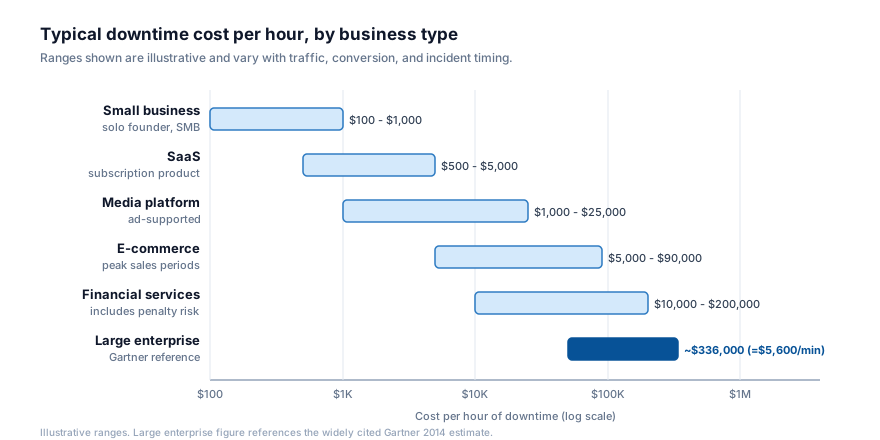
The financial impact of downtime varies significantly depending on your business model and industry. Here is how it breaks down across major sectors:
- SaaS and Subscription Businesses: Downtime directly threatens monthly recurring revenue. Every minute your app is unreachable, users cannot log in, workflows stall, and trust erodes. Extended or repeated outages drive churn. Customers cancel not because of one incident, but because they lose confidence in reliability. A SaaS product with $50K MRR losing just 0.5% of subscribers per outage faces compounding revenue loss over time.
- E-commerce: Online stores lose transactions the moment the site goes down. Shoppers do not wait: they leave and buy from a competitor. Cart abandonment spikes during even brief disruptions, and many of those customers never return. During peak sales periods like Black Friday or product launches, a few minutes of downtime can mean tens of thousands in lost sales.
- Media and Content Platforms: Ad-supported sites lose revenue with every page that fails to load. If your monetization depends on impressions and clicks, downtime translates directly into lost advertising income. High-traffic content sites can lose hundreds of dollars per minute during peak hours.
- Financial Services: Downtime in financial applications carries regulatory and compliance risks on top of revenue loss. Failed transactions, missed trading windows, and data access interruptions can trigger penalties and erode client trust in ways that take months to repair.
- Small Businesses and Solo Founders: When you are a one-person team or a small crew, every dollar of revenue matters. A $2,000 outage might represent an entire week of profit. Worse, small businesses often lack the redundancy and support staff to recover quickly, making fast detection even more critical.
The Hidden Costs of Downtime
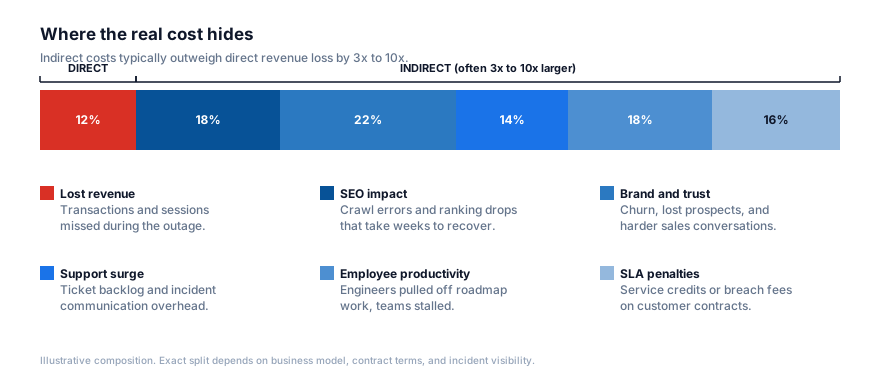
Direct revenue loss is only the most visible cost. The hidden costs of downtime often exceed the immediate financial impact and can linger long after the incident is resolved:
- SEO Ranking Damage: Search engines penalize sites that are frequently unavailable. If Googlebot encounters errors during a crawl, your rankings can drop and recovering lost positions takes weeks or months of consistent uptime.
- Brand and Customer Trust: When Basecamp went down for hours in 2023, the incident made Hacker News and Twitter. Months later, prospects still asked about it during sales calls. A single visible outage can define how people talk about your product, and repeated incidents push existing customers toward competitors.
- Support Ticket Surge: Every outage generates a wave of support requests. Your team spends hours responding to tickets and managing communications instead of building product. For small teams, this opportunity cost is enormous.
- Employee Productivity Loss: Internal teams that depend on your application lose productive time during outages. Developers drop what they are working on to investigate. Sales teams cannot demo the product. The ripple effect across the organization is significant.
- SLA Breach Penalties: If you have committed to uptime SLAs in your contracts, downtime can trigger financial penalties, service credits, or even contract termination. The cost of an SLA breach often exceeds the direct revenue lost during the outage itself.
How to Calculate Your Downtime Cost
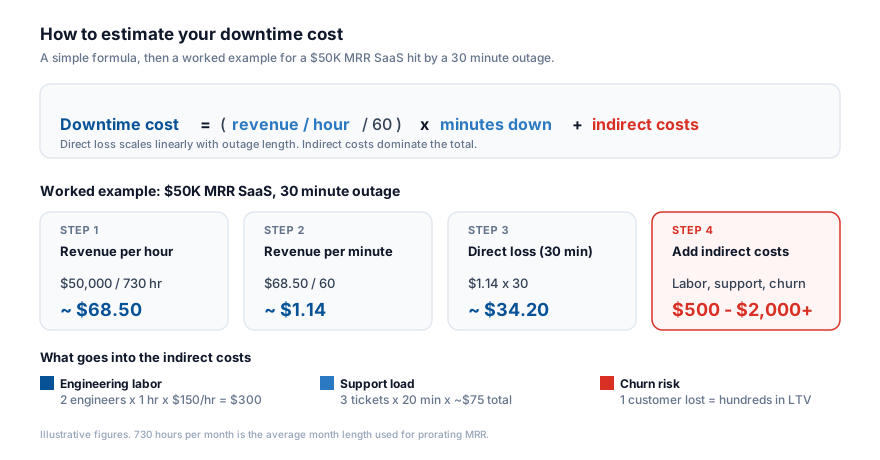
Knowing the general statistics is useful, but you need to understand what downtime costs your specific business. The basic formula is straightforward:
Downtime Cost = (Revenue per hour / 60) x Minutes of downtime + Indirect costs
Let us walk through a worked example. Imagine you run a SaaS product generating $50,000 in monthly recurring revenue:
- Revenue per hour: $50,000 / 730 hours per month = approximately $68.50 per hour
- Revenue per minute: $68.50 / 60 = approximately $1.14 per minute
- Direct cost of a 30-minute outage: $1.14 x 30 = $34.20 in lost revenue
That direct figure looks small, but now add the indirect costs. If two developers spend an hour investigating and fixing the issue at a blended rate of $150 per hour, that is $300 in labor. If three customers submit support tickets requiring 20 minutes each to resolve, add another $75 in support costs. If one customer churns next month partly due to this incident, that is potentially hundreds or thousands in lost lifetime value.
Suddenly a 30-minute outage for a modest $50K MRR SaaS can easily cost $500 to $2,000 or more when you account for the full picture. Scale that up to a $500K MRR product and the numbers become staggering. The key insight is that indirect costs typically outweigh direct revenue loss by a factor of 3x to 10x.
Why Detection Speed Matters
You cannot eliminate downtime entirely, but you can control how quickly you detect and respond to it. Detection speed is the single biggest lever you have for reducing downtime costs, and the math is simple.
Most monitoring tools check your site every 5 minutes. That means if your site goes down one second after a check, it will not be detected for nearly 5 minutes. Factor in another check cycle to confirm the outage, and your maximum undetected downtime is roughly 10 minutes. At $5,600 per minute, that is $56,000 in potential losses before you even know there is a problem.
With 30-second monitoring, the maximum undetected window drops to under 1 minute. The difference is dramatic:
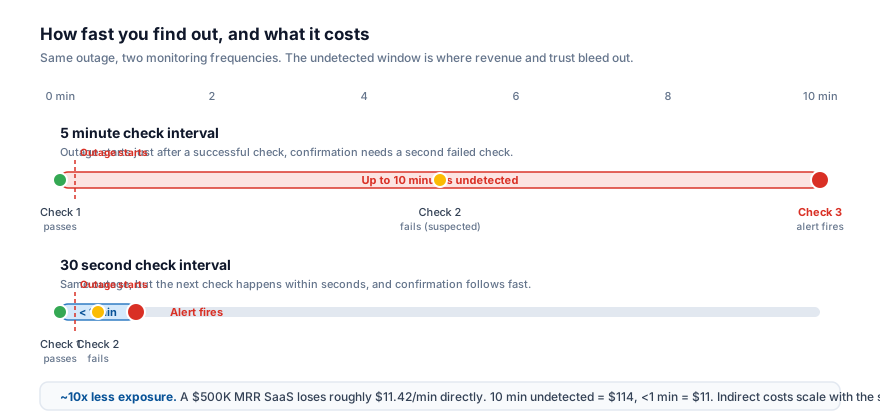
- 5-minute checks: Up to 10 minutes undetected. At $2.28 per minute (a $100K MRR SaaS), that is $22.80 in direct revenue exposure per incident. Scale that to a $500K MRR business and the per-minute cost hits $11.42.
- 30-second checks: Under 1 minute undetected. Same business, same incident, but $2.28 in direct revenue exposure.
That is a 10x reduction in exposure from detection speed alone. And the indirect costs scale proportionally. Shorter outages mean fewer support tickets, less customer frustration, and a smaller blast radius.
This is exactly why 5-minute uptime checks are not enough for any business where downtime has real financial consequences. The gap between knowing in 30 seconds and knowing in 10 minutes is the difference between a minor blip and a costly incident.
Reducing Downtime Costs with Early Detection
The most effective way to reduce downtime costs is to detect problems faster and respond immediately. PingPing checks your websites every 30 seconds from multiple global locations, giving you the fastest possible alert when something goes wrong.
When an outage is detected, PingPing sends alerts through multiple channels (SMS, Slack, email, and webhooks) so you and your team are notified within seconds, not minutes. The faster you know, the faster you can act, and the less the incident costs your business.
For solo founders and small teams, this is especially critical. You cannot afford to have someone watching dashboards around the clock. You need a monitoring tool that watches for you and tells you the moment something breaks, whether it is 3 PM on a Tuesday or 3 AM on a Sunday.
Pair fast detection with a public status page and you also reduce the support burden during incidents. Customers can check the status page instead of filing tickets, giving your team more time to focus on resolving the issue. For inspiration, see how leading companies handle this in our status page examples.
Every minute of downtime has a price tag. The question is not whether you can afford monitoring - it is whether you can afford not to have it. See how PingPing compares to UptimeRobot, Pingdom, and other monitoring tools.
Never miss an expiry
PingPing checks your site every 30 seconds and alerts you the moment something breaks, so you keep your downtime window - and your downtime costs - as small as possible.
Related guides
What is uptime monitoring?
How uptime monitoring works and why check frequency is the key variable in your downtime exposure.
What is 30-second monitoring?
Why 30-second checks cut your undetected downtime window by 10x compared to standard 5-minute tools.
Why 5-minute uptime checks aren't enough
The math behind detection gaps and how slower checks silently inflate your real downtime costs.
What to do when your SaaS is down
A calm 5-step response checklist, customer communication templates, and a post-mortem framework for the moment it happens.